

JEREMY GRIFFITH, BIOLOGIST
Jeremy Griffith is an Australian biologist best known for his pioneering work on the human condition. Raised on a sheep station in rural New South Wales, he attended Geelong Grammar School in Victoria, one of the world’s leading schools. Demonstrating an early aptitude for science, he earned first-class honours in biology in the state matriculation exams before beginning a science degree at the University of New England in 1965. During his university years, he also excelled in sport, reaching the 1966 trials for Australia’s national rugby union team, the Wallabies.
In 1967, Jeremy deferred his studies to pursue a driven mission to save the Thylacine, or ‘Tasmanian Tiger’, from extinction. Hitchhiking to Tasmania, he dedicated over six years to what became the most extensive investigation ever into the fate of this elusive marsupial. Though the search concluded with the Thylacine presumed extinct, it gained widespread attention, appearing in Natural History (the journal of the American Museum of Natural History), Australian Geographic, and the popular television series A Big Country.
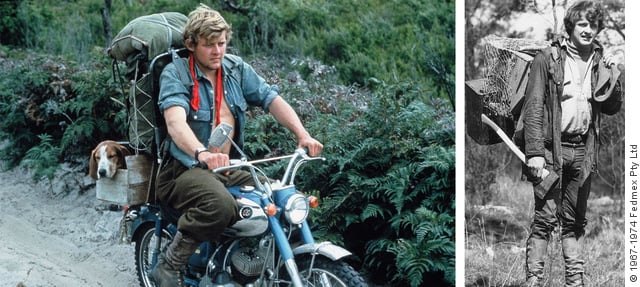 Setting off with nothing but his own enthusiasm, initiative and ingenuity — as these photos illustrate — Jeremy Griffith tried to rediscover and save the Tiger from extinction. The right-hand photo is of Jeremy carrying the ingredients to set up a trial camera monitor. He modified cameras for this purpose, and he is credited with having pioneered the now widely practised use of trail cameras to assess the presence or otherwise of threatened species.
Jeremy completed his Bachelor of Science in zoology at the University of Sydney in 1971. The following year, he launched Griffith Tablecraft, a furniture design and manufacturing business known for its simple, natural aesthetic. Alongside his work in design, he also pursued visual art, becoming a talented artist.
 One of Jeremy’s favourite artists is the aboriginal painter Emily Kame Kngwarreye. Emily’s astonishing ability to express pure beauty comes from her unimpeded access to her soul (our species’ fully cooperative, all-loving and all-feeling original instinctive self). Emily lived in the desert country of central Australia and didn’t see a white person until she was 16, and only started painting when she was 80! Jeremy recreated one of Emily’s paintings because he loved them so much and couldn’t afford to buy one. He acknowledges this at the bottom of the painting by calling it a ‘Jemily’. It can be seen on the wall in the background of many of the videos on our website.
However, at age 27, Jeremy experienced a turning point. He came to see that neither conservation efforts nor building embellishment free furniture was truly addressing the root cause of the dysfunction and suffering in human life. The real issue lay in understanding the human condition – our species’ conflicted capacity for both good and evil. From that moment, Jeremy realised that as a biologist he needed to understand human behavior, which from then on became his life’s focus.

 Jeremy Griffith at his writing desk in Surry Hills, Sydney in 1982 where he did a great deal of his fundamental thinking about the human condition. He also lived and maintained a showroom for his furniture business there.
Jeremy began writing on the subject in 1975 and, in 1983, founded the World Transformation Movement (WTM) — a not-for-profit organisation dedicated to exploring and resolving the human condition. Over the decades, he has published a number of books, including the 2004 bestseller A Species In Denial and his 2016 magnum opus, FREEDOM: The End Of The Human Condition.

Jeremy Griffith’s complete biography is available at HumanCondition.com.